Our Research Approach
The QTPIE Lab at CSU-Northridge is dedicated to a compassionate and intersectional approach in psychology research. Our focus is on centering the experiences of diverse LGBTQ+ communities to understand mental health disparities and foster resilience. We are committed to designing and implementing affirming interventions and measures, and our research opportunities are aimed at conducting LGBTQ-affirming and empowering psychological research. Our goal is to create a supportive and inclusive space for undergraduate and graduate-level students from CSU-Northridge to engage in meaningful research that makes a difference in the lives of LGBTQ+ individuals.
The QTPIE Lab is a psychology research lab focused on centering the experiences of diverse LGBTQ+ communities. Using multicultural and intersectional lenses, the lab aims to understand mental health disparities, design and implement affirming interventions and measures, and foster resilience among intersectional LGBTQ+ individuals. The lab offers research opportunities dedicated to conducting LGBTQ-affirming and empowering psychological research for undergraduate and graduate-level students from CSU-Northridge. The goals for The QTPIE Lab include reaching potential research participants, collecting survey data, filling gaps in the literature to be inclusive of LGBTQ+ population, creating affirming interventions for Queer POC, and showcasing current projects and achievements.
The Lab addresses a wide range of mental health concerns and issues including but not limited to depression, anxiety, relationship difficulties, life transitions, self-esteem, adverse childhood experiences (ACEs), post-traumatic stress disorder, medical and health concerns, pain management, stress management, gender identity support, LGBT counseling, and other relevant issues.
Together, the lab supports one another during our efforts to create a more inclusive and accepting environment all while improving and gaining valuable research experience in a supportive and collaborative environment.
Interested in joining? Click here to learn more!

Our Projects
Bisexuality Needs Assessment
The Bisexuality Needs Assessment (BNA) is the first queer-centered project developed by our lab. This online survey was distributed to bisexual+ individuals in the United States and aims to answer a variety of research question proposed by current lab members. By focusing solely on bisexual+ community, this project aims to fill critical gaps in the current LGBTQ+ literature as bisexual participants are often grouped with other LGBTQ+ populations. The Lab has now presented some of our findings at the APA, APS, and WPA conferences, with presentations for SPSSI planned this year.
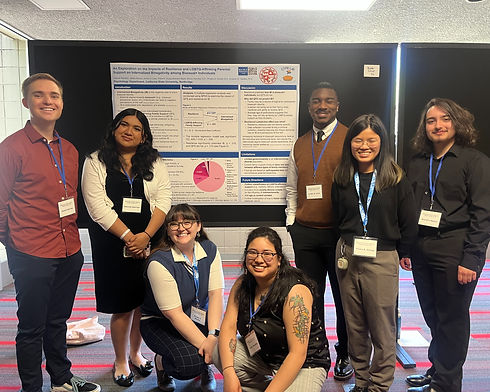
An Exploration on the Impacts of Resilience and LGBTQ-Affirming Parental Support on Internalized Binegativity among Bisexual+ Individuals
Hannan Ramirez, James Darrow, Jordan A. Lane, Trisha K. Voung, Brandon Nejad, Sharon Sanchez, B.A.. Phoebe G. Shorter, M.A. & Adrian M. Valadez, Ph.D.
Parental support specific to the needs of a child is a protective factor that builds resilience, regardless of sexual orientation or gender identity. However, existing research fails to account for the unique experiences of bisexual+ (e.g., bisexual, pansexual, queer, etc.) adults and the impact this support has on levels of internalized binegativity (IB). This study
examines the impact that resilience and LGBTQ-affirming parental support have on IB for bisexual+ adults. Using data from a mental health needs assessment of approximately 450 bisexual+ participants, measures related to IB, resilience, and LGBTQ-affirming family support were administered. A multiple-regression analysis was utilized to examine predictive
relationships among variables. Results indicated an inverse relationship among variables suggesting that higher levels of resilience and LGBTQ-affirming family support will lead to lower levels of IB.
A Personality-Based Approach to Understanding Life Satisfaction and Gender-Fluidity Among Bisexual+ Adults
Avryel L. Arias, Emma Salmon, B.S., Andye H. Lam, Adrian M. Valadez, Ph.D.

There is an interlocking connection between gender-fluid (e.g., non-binary, transgender, two-spirit) and bisexual+ identities (e.g., bisexual, pansexual, queer). However, limited research has explored how varying degrees of gender fluidity may be associated with specific personality traits and whether this fluidity can predict subjective well-being. The current exploratory study
centers the intersections of both bisexual+ and gender fluid identities. We aimed to provide insights into the associations among gender identity, satisfaction with life, and personality traits such as openness and empathy. We hypothesized that gender fluidity positively predicts openness, perspective-taking, and satisfaction with life.
A total of 450 adult bisexual+ participants were recruited from Prolific, an online crowdsourcing platform. Participants completed an online survey via Qualtrics to gauge openness to experience. A multiple regression analysis was conducted to examine the direct relationship between gender fluidity and three outcome variables: openness, perspective-taking, and satisfaction with life. Gender fluidity was entered as the independent variable, while openness, perspective-taking and satisfaction with life were the dependent variables. Relevant demographic variables and correlates to bisexual mental health, such as age, were entered as covariates to further specify the model.
Results indicated that gender fluidity has a positive relationship with openness, perspective-taking and satisfaction with life, suggesting that greater variability in gender identity among bisexual+ individuals may align with relevant personality traits to foster adaptability and better individual well-being.

Adverse Childhood Experiences & Well-Being in Bisexual+ Adults: The Role of Resilience as a Moderator
Miles Palma, B.A., Sharon Sanchez, B.A., Ashlye Arrue, Naira Harutyunyan, B.A., Phoebe G. Shorter, M.A., & Adrian M. Valadez, Ph.D.
Bisexual+ (e.g., bisexual, pansexual, queer, etc.) individuals represent the largest and most understudied subpopulation of the LGBTQ+ community. Additionally, bisexual+ individuals are at the highest risk for negative health outcomes such as
depression and suicidality, compared to both heterosexuals and other monosexual groups like gay men and lesbians. The study measured generalized adverse childhood experiences (ACEs), such as abuse, neglect, and household dysfunction, as well as sexual and gender minority (SGM) ACEs. SGM-ACEs encompass queer-specific experiences, such as transphobia, homophobia, biphobia, or abuse from family members, religious leaders, or at school. While ACEs are known to have negative effects on overall well-being, resilience has been shown to have positive effects. This study has examined the
role of resilience as a potential moderator for the impacts of generalized ACEs and SGM-ACEs on bisexual+ individuals’ emotional, social, and psychological health and overall well-being. We assessed whether resilience moderates the relationship that both generalized ACEs and SGM-ACEs have on overall well-being. Additionally, we examined
whether this effect remained for all forms of ACEs, or if it buffered against certain types of ACEs within this population.
We found resilience did not reduce the impact both generalized ACEs and SGM-ACEs had on overall well-being. However, our model did show that higher ACEs and SGM ACEs scores resulted in higher higher distress. Results also found that between the two ACEs, SGM-ACEs has a stronger effect on distress. Our results demonstrate the importance of supporting LGBT+ youth, particularly in bisexual+ populations. These findings will help inform future research for those wanting to affirm bisexual+ individuals.
Bisexual+ Adult Mental Health: The Impact of Parenting Styles and Religiosity
Catherine A. Martinez, Nathaniel Robles, Ashlye Arrue, Emma Salmon, B.S., & Adrian M. Valadez, Ph.D.

Bisexual individuals experience higher rates of mental health challenges, such as anxiety and depression, than their heterosexual counterparts. Restrictive environments where individuals lack autonomy and environments where individuals encounter high levels of prejudice and discrimination can further increase mental health challenges. Some examples of these environments may include the involvement with highly restrictive religious organizations or homes led by authoritarian parental units. Not only do some highly restrictive religious environments neglect mental health assistance, but their beliefs and practices have also been found to be non-affirming for bisexual individuals. Additionally, parenting styles can have an impact on an individual’s mental health through experienced anxiety and depressive symptoms, social functioning and relationships, and self-esteem. In an effort to further understand the nature of this impact, we examined how bisexual adults’ home environment (influenced by parenting style and frequency of religious activities in the home) in childhood has impacted their mental well-being in adulthood.
Results indicated that more restrictive environments, present through high religiosity and/or authoritarian parenting styles, contribute to higher levels of anxiety and depression and lower levels of outness (i.e., higher degrees of concealment) for bisexual+ individuals. Additionally, results showed that less restrictive environments, present through low religiosity and/or authoritative parenting styles, helped mitigate some of this impact via lower anxiety, depression, and concealment for bisexual+ adults.

Reducing Suicide in Bisexual + Adults: The Role of LGBTQ-Specific Support Combating ACE-Related Risk
Phoebe G. Shorter, M.A., Naira Harutyunyan, B.A., Miles Palma, B.A., Catherine A. Martinez, B.A., & Adrian M. Valadez, Ph.D.
Adverse childhood experiences (ACEs), such as abuse and neglect, can increase suicide risk. Bisexual populations report more suicidal ideation (SI) and higher rates of ACEs than non-bisexual peers, demonstrating that bisexual individuals with ACEs need targeted suicide prevention strategies. LGBTQ-specific social support (SS) can be more beneficial than general SS in reducing distress among non-heterosexual individuals, but little is known about how protective it can be against SI for bisexuals specifically. This study assesses whether, in a sample of bisexual+ people (e.g., bisexual, pansexual, queer, etc.), LGBTQ-specific SS more effectively protects against ACEs’ impact on SI compared to other forms of SS.
Adult, bisexual participants (n = 450) were recruited through a crowdsourcing site (Prolific) to complete a comprehensive, online mental health survey. The survey included measures that assessed suicidal ideation, adverse childhood experiences (both generalized and sexual and gender-minority (SGM) specific), and how supported one feels by their family, heterosexual friends, and LGBTQ peers. Three multiple linear regressions examined how social support from family, heterosexual friends, and LGBTQ peers function as protective factors in the pathways from generalized ACEs and SGM-ACEs to SI. Results suggest that generalized ACEs and SGM-ACEs increases SI, and that all SS types weaken the effect that generalized ACES has on SI. Additionally, LGBTQ-specific SS has the strongest buffering effect compared to SS from family and heterosexual friends. Additionally, increased LGBTQ-specific SS also reduced the impact SGM-ACEs has on SI, while family and heterosexual friends’ support did not. As bisexual individuals from intersectional backgrounds experience discrimination and alienation from communities, which can increase SI, findings illustrate the importance of receiving multiple forms of social support and its ability to reduce SI in bisexual people with ACEs. Additionally, our results inform future research on how to best support this under-researched population.
/Why is Relevant

Do Outness and Relationship Satisfaction Mitigate Suicidal Ideation Amongst Bisexuals?
Naira Harutyunyan, B.A., Avryel Arias, Catherine A. Martinez, B.A., Phoebe G. Shorter, M.A., & Adrian M. Valadez, Ph.D.
Bisexual individuals make up more than half of the LGBTQ+ population. It is integral to investigate the mental health of bisexuals because bisexuals exhibit higher rates of suicidal ideation when compared to their monosexual counterparts. Furthermore, it is integral to better understand risk and resiliency factors that may influence suicidal ideation risk for this demographic. According to the Interpersonal Theory of Suicide, reduced feelings of belongingness and increased sense of burdensomeness due to discrimination may increase suicide risk. We hypothesized that relationship satisfaction, outness, and an interaction between those two variables would significantly predict the degree of suicidal ideation. We recruited bisexual+ participants through Prolific, a crowdsourcing site, and surveyed them using Qualtrics. Participants completed an extensive mental health assessment. For the purposes of the current study, only responses on the Nebraska Outness Scale, Relationship Assessment scale (the original and a modified version suitable for polyamorous individuals), and the Positive and Negative Suicide Ideation Inventory were utilized in analyses.
Multiple regressions were conducted to evaluate potential predictors of suicidal ideation amongst bisexual+ adults. Relationship satisfaction moderately predicted lower rates of suicidal ideation. General outness significantly predicted higher rates of suicidal ideation, but had a fairly small effect overall. All findings were based on cross-sectional self-reports and should be qualified accordingly. With that in mind, this study implicates the power that a fulfilling partnership can hold in protecting individuals from experiencing thoughts of suicide. It also shows how protective healthy relationships can be, for both monogamous and polyamorous members of the bisexual+ community. In future research, we are interested in exploring how outness to various social groups may impact suicidal ideation.